Wheeled Adventure
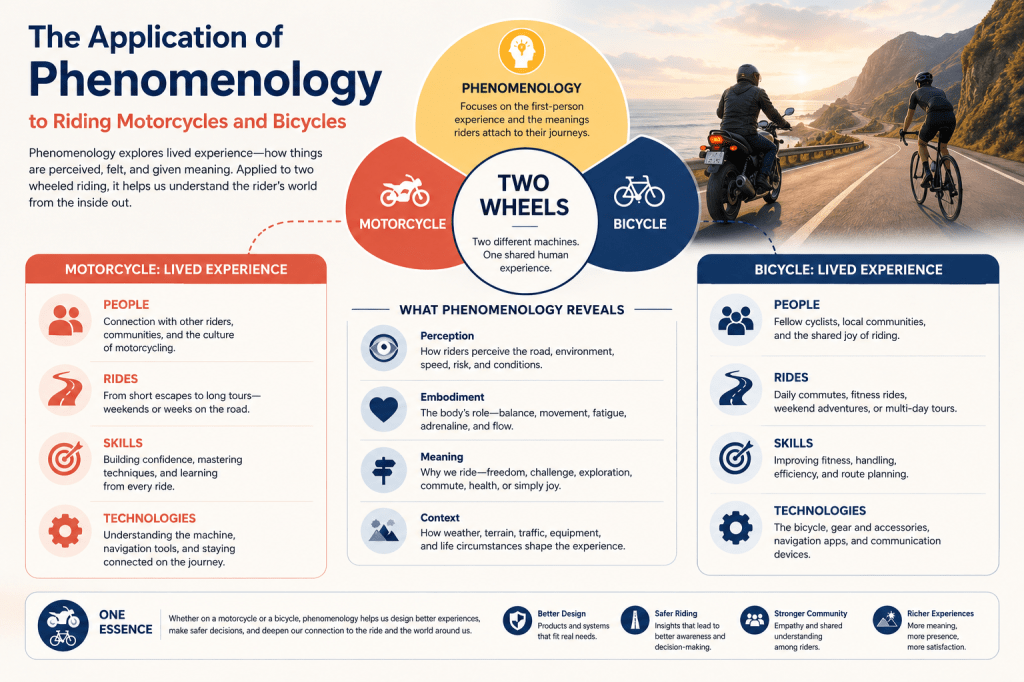
Why Two Wheels? Two-wheeled machines require continuous input. In a car, we ride in a bubble, insulated from nearly everything beyond the tinted windows and the controlled environment.
Phenomenology is a word that I repeatedly misspell.
Phenomenology is the careful study of conscious experience as it is lived and perceived, before theories, assumptions, or scientific explanations are added.
If philosophy were a traffic accident:
- A physicist measures the skid marks.
- An engineer inspects the brakes.
- A lawyer asks who is liable.
- A phenomenologist asks: “Can we take a moment to explore what the collision felt like?”
Because operating a two-wheeled machine is continuous, I sought to dive deeper into how I perceive the experiences.
I began on a bicycle. I imagine every child is introduced to the bicycle, first with training wheels, then comes a day when the extra pair of wheels are removed — and with a loving shove, the parents shriek with pride and joy as junior wobbles down the sidewalk. Freedom! The child can now roam for miles — his world radically expands, liberated by a pair of wheels.
Armed with a few weeks of experience pedaling the two wheels, clothespins and playing cards attached to the spokes sound like a motor. Terrific idea! Motorize the bicycle!
My parents gave me a motorcycle when I was 15 and a half, I obtained a permit and began riding Northern California freeways and backroads.
The motorcycle was when I began to think about what I was experiencing.
Robert Pirsig’s Zen and the Art of Motorcycle Maintenance was required reading. I digested and regurgitated as necessary for the course — but I did not appreciate it.

